
0 comment Wednesday, April 30, 2014 | admin

The NASA Voyager probes which were sent out in 1977, are now more than 14 billion kilometres from Earth, and are approaching the Sun's influence.
The Voyagers are still sending back data, and computer modelling based on this information suggests that there is some interesting bubble-like activity happening at the edge of our Solar System.
"Computer modelling based on the Voyager insights suggests the edge of our Solar System is a froth of activity, like "an agitated jacuzzi", said Eugene Parker from the University of Chicago, US. Magnetic field lines carried in the "wind" of material coming off our star are breaking and reconnecting. This process is sculpting the wind into discrete bubbles that are many tens of millions of kilometres wide."Read more.
In my research, I have been researching the universality of roundness and studying the characteristics and behaviour of soap bubbles. Consequently, the idea of bubble-like activity happening in Space, is very exciting!
Labels: Art, Bbc, Bubbles, Magnetism, Nasa, Space, The Shape Of Our Universe, The Sun, Universality Of Roundness, Universe
0 comment Friday, April 25, 2014 | admin
On the NASA website, you can download multimedia relating to various aspects of their research.
Thankfully, some helpful youtube people have uploaded the multimedia to youtube for easy streaming.
Yes, there is no sound in space, but the Cassini spacecraft has recorded radio-waves coming from Saturn's poles and converted them to something that we can actually hear. Saturn has auroras similar to Earth's Aurora Borealis, and that is what we are hearing in this clip.
The original recording was actually 27 minutes long and has been shortened to 73 seconds so that we can make out the rising and falling sounds of the aurora.
Thankfully, some helpful youtube people have uploaded the multimedia to youtube for easy streaming.
Yes, there is no sound in space, but the Cassini spacecraft has recorded radio-waves coming from Saturn's poles and converted them to something that we can actually hear. Saturn has auroras similar to Earth's Aurora Borealis, and that is what we are hearing in this clip.
The original recording was actually 27 minutes long and has been shortened to 73 seconds so that we can make out the rising and falling sounds of the aurora.
Labels: Aurora, Music, Nasa, Saturn, Sound
0 comment Thursday, April 17, 2014 | admin
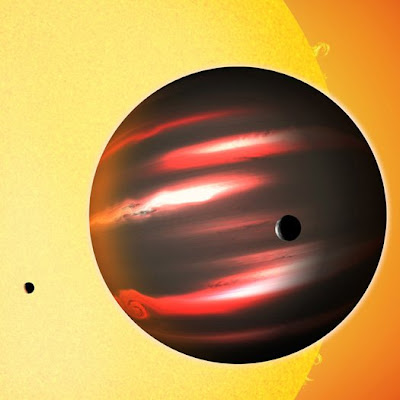 The NASA's Kepler spacecraft has discovered the "blackest planet ever found", TrES-2b reflects just 1% of light. Scientists do not know why TrES-2b reflects so little light, but have observed the planet emitting a faint red light similar to glowing embers.
What I personally find most interesting, is that the astronomer David Kipping has compared TrES-2b's reflection of light to black acrylic paint.
Find out more at PopSci and the Centre For Astro-Physics Press Release.
Labels: Black, Black Planet, Exploration, Nasa, Planet, Space, Tres-2B, Universe
0 comment Monday, March 24, 2014 | admin
I have recently discovered the astronomical drawings of Étienne Léopold Trouvelot.Trouvelot made a living as a portrait artist, but became increasingly interested in astronomy when sketching and observing the aurora borealis.

The Aurora Borealis.
The quality of these drawings caught the attention of the astronomers at Harvard University, who then invited Trouvelot to use their telescopes. In total, Trouvelot completed 7,000 drawings in fine detail.
These astronomical drawings were mostly completed between the years of 1870 and 1885, so I thought it would be interesting to compare what Trouvelot saw to the photographs we have now.

A drawing of the Orion Nebula.

The Orion Nebula as photographed by NASA.

The Milky Way as seen from earth.

The Milky Way photographed by Tom Lowe: Astronomy Photographer Of The Year 2010

Trouvelot's drawing of Jupiter.

Jupiter as photographed by NASA

Trouvelot's drawing of Saturn

Saturn, photographed by NASA.

A total eclipse of the Sun.

A total eclipse of the Sun, photographed by Michael Kobusch.

Sun spots as discovered by Trouvelot.

Active Region 1302 photographed by Alan Friedman.
It is interesting to compare these, as you can see where Trouvelot has added artistic flourishes. The Trouvelot drawings fascinate me for this reason, the drawings are not true copies and light is portrayed as being quite linear.However, the artist impressed astronomers enough to have a crater on the moon named after him!
If you consider photographs of such phenomena taken in the same time period, you begin to see why. This is the first photograph of the Orion Nebula taken in 1880 by Professor Henry Draper:

Three years later, using a long exposure, Henry Draper improved his photograph of the Orion Nebula:

The Trouvelot drawings were very up to the minute at this time, his work celebrates an era of astronomical discovery.
The Aurora Borealis.
The quality of these drawings caught the attention of the astronomers at Harvard University, who then invited Trouvelot to use their telescopes. In total, Trouvelot completed 7,000 drawings in fine detail.
These astronomical drawings were mostly completed between the years of 1870 and 1885, so I thought it would be interesting to compare what Trouvelot saw to the photographs we have now.
A drawing of the Orion Nebula.
The Orion Nebula as photographed by NASA.
The Milky Way as seen from earth.
The Milky Way photographed by Tom Lowe: Astronomy Photographer Of The Year 2010
Trouvelot's drawing of Jupiter.
Jupiter as photographed by NASA
Trouvelot's drawing of Saturn
Saturn, photographed by NASA.
A total eclipse of the Sun.
A total eclipse of the Sun, photographed by Michael Kobusch.
Sun spots as discovered by Trouvelot.
Active Region 1302 photographed by Alan Friedman.
It is interesting to compare these, as you can see where Trouvelot has added artistic flourishes. The Trouvelot drawings fascinate me for this reason, the drawings are not true copies and light is portrayed as being quite linear.However, the artist impressed astronomers enough to have a crater on the moon named after him!
If you consider photographs of such phenomena taken in the same time period, you begin to see why. This is the first photograph of the Orion Nebula taken in 1880 by Professor Henry Draper:
Three years later, using a long exposure, Henry Draper improved his photograph of the Orion Nebula:
The Trouvelot drawings were very up to the minute at this time, his work celebrates an era of astronomical discovery.
Labels: Alan Friedman, Astronomy, Aurora, Drawing, Eclipse, Etienne Leopold Trouvelot, Jupiter, Michael Kobusch, Nasa, Orion Nebula, Saturn, Sun Spots, The Milky Way, Tom Lowe, Trouvelot