
0 comment Saturday, May 31, 2014 | admin
 Post Secret
When I was a young girl, I was introduced to the concept of endless time and space, and this used to give me panic attacks.
Subsequently, I blocked out my thoughts about infinity, and it was only in the Summer of 2010 when I confronted my fears through reading "A Short History Of Nearly Everything" by Bill Bryson, and felt comforted that some scientists believe that the universe and time itself, is bent. Finite yet boundless.
"The question that has occurred to all of us at some point is what would happen if you travelled out to the edge of the universe?
What would you find beyond?
The answer disappointingly, is that you can never get to the edge of the universe. That's not because it would take too long to get there, because it would take too long to get there, though of course it would - but because even if you travelled outward and outward in a straight line, indefinitely and pugnaciously, you would never come at and outer boundary. Instead, you would come back to where you began (at which point, presumably, you would rather lose heart and give up).
The reason for this is that the universe bends in a way we can't adequately imagine, in a conformance with Einsteins theory of relativity.
For the moment it is enough to know that we are not adrift in some large, ever expanding bubble. Rather, space curves in a way that allows it to be boundless yet finite"
As I started to use these concepts in my art practice, people came forward to say that they too had suffered anxiety and panic from thinking about the infinite.
This Post Secret is great, as it illustrates that troubling thoughts of infinity are universal, and can manifest in pure creative gesture.
Labels: A Short History Of Nearly Everything, Bill Bryson, Eternity, Infinity, Post Secret
0 comment Monday, May 26, 2014 | admin
A few months ago, I made a post explaining how thinking about eternity gave me panic attacks.
I was comforted by Bill Brysons' idea of a "finite yet boundless" universe as opposed to the idea of the universe as an ever-expanding bubble.
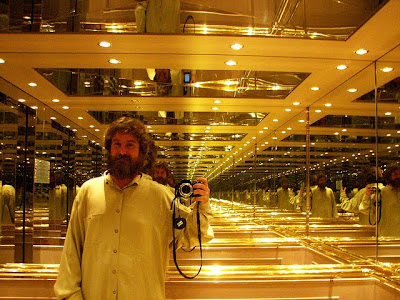
I was inspired when I came across Markus Spiering's photo-set on Flickr, as he has featured photographs based around the concept of "Lift Infinity".
 Source
Source

Source
There is certainly something interesting about a four sided mirrored box reflecting inwards, a new way of thinking about a finite, boundless form.
I was comforted by Bill Brysons' idea of a "finite yet boundless" universe as opposed to the idea of the universe as an ever-expanding bubble.
I was inspired when I came across Markus Spiering's photo-set on Flickr, as he has featured photographs based around the concept of "Lift Infinity".
SourceSource
Source
There is certainly something interesting about a four sided mirrored box reflecting inwards, a new way of thinking about a finite, boundless form.
Labels: Eternity, Flickr, Infinity, Lift, Markus Spiering, Photography
0 comment Friday, May 23, 2014 | admin
In 1960, Roman Opalka began on a journey, painting the numbers from 1 to Infinity.
Opalka once said that he would be happy to reach the number 7,777,777 which is a number he said had "profound meaning".
Unfortunately, Roman Opalka died on the 6th of August 2011 and is thought to have reached just short of 6,000,000.
Opalka's work essentially illustrates the passing of time, stroke by stroke, day after day, year after year.
The artist described his work as a journey "a philosophical and spiritual image of the progression of time and of life and death�.


Time as we live it and as we create it embodies our progressivedisappearance; we are at the same time alive and in the face of death�that is the mystery of all living beings. The consciousnessof this inevitable disappearance broadens our experiences withoutdiminishing our joy. There is always the omnipresent idea ofnature, of its ebb and flow of life. This essence of reality can be universally understood; it is not only mine but can be commonlyshared in our unus mundus. (Trad. Mark Selwyn) Roman Opalka - "Rencontre par la séparation", AFAA, Paris, 1987
Time is a concept we can all relate to, most of us have witnessed a clock ticking and celebrated a New Year. However, Opalka took it upon himself to show this passing of time very physically.


The concept of infinity and endlessness is a terrifying prospect for me, personally. As a child, I was introduced to the concept of endless time and space, and the idea blew my tiny little mind! I could not think about anything related to space for a long time without feeling anxious.
However, in the last year of my undergraduate degree, I decided to confront my fear in a similar way to Yayoi Kusama, through repetitive art practice. Compared to Roman Opalka, my efforts were puny, but I spent two months repetitively winding wool to create a large chain sculpture.
The repetitive winding put me in to a calm state of madness leaving my brain feeling a little fried after each winding session, I could not keep up the project for longer than two months and was glad to see the back of it.
It is therefore, astounding to me, that an artist could dedicate over fifty years to continually painting numbers.
The Telegraph wrote an obituary for Roman Opalka which you can read here.
Opalka once said that he would be happy to reach the number 7,777,777 which is a number he said had "profound meaning".
Unfortunately, Roman Opalka died on the 6th of August 2011 and is thought to have reached just short of 6,000,000.
Opalka's work essentially illustrates the passing of time, stroke by stroke, day after day, year after year.
The artist described his work as a journey "a philosophical and spiritual image of the progression of time and of life and death�.
Time as we live it and as we create it embodies our progressivedisappearance; we are at the same time alive and in the face of death�that is the mystery of all living beings. The consciousnessof this inevitable disappearance broadens our experiences withoutdiminishing our joy. There is always the omnipresent idea ofnature, of its ebb and flow of life. This essence of reality can be universally understood; it is not only mine but can be commonlyshared in our unus mundus. (Trad. Mark Selwyn) Roman Opalka - "Rencontre par la séparation", AFAA, Paris, 1987
Time is a concept we can all relate to, most of us have witnessed a clock ticking and celebrated a New Year. However, Opalka took it upon himself to show this passing of time very physically.
The concept of infinity and endlessness is a terrifying prospect for me, personally. As a child, I was introduced to the concept of endless time and space, and the idea blew my tiny little mind! I could not think about anything related to space for a long time without feeling anxious.
However, in the last year of my undergraduate degree, I decided to confront my fear in a similar way to Yayoi Kusama, through repetitive art practice. Compared to Roman Opalka, my efforts were puny, but I spent two months repetitively winding wool to create a large chain sculpture.
The repetitive winding put me in to a calm state of madness leaving my brain feeling a little fried after each winding session, I could not keep up the project for longer than two months and was glad to see the back of it.
It is therefore, astounding to me, that an artist could dedicate over fifty years to continually painting numbers.
The Telegraph wrote an obituary for Roman Opalka which you can read here.
Labels: Algorithms, Anxiety, Arrow Of Time, Art, Endlessness, Entropy, Eternity, Infinity, Mathematics, Melanie K, Numbers, Painting, Philosophy, Roman Opalka, Time, Yayoi Kusama