
0 comment Friday, May 23, 2014 | admin
In 1960, Roman Opalka began on a journey, painting the numbers from 1 to Infinity.
Opalka once said that he would be happy to reach the number 7,777,777 which is a number he said had "profound meaning".
Unfortunately, Roman Opalka died on the 6th of August 2011 and is thought to have reached just short of 6,000,000.
Opalka's work essentially illustrates the passing of time, stroke by stroke, day after day, year after year.
The artist described his work as a journey "a philosophical and spiritual image of the progression of time and of life and death�.


Time as we live it and as we create it embodies our progressivedisappearance; we are at the same time alive and in the face of death�that is the mystery of all living beings. The consciousnessof this inevitable disappearance broadens our experiences withoutdiminishing our joy. There is always the omnipresent idea ofnature, of its ebb and flow of life. This essence of reality can be universally understood; it is not only mine but can be commonlyshared in our unus mundus. (Trad. Mark Selwyn) Roman Opalka - "Rencontre par la séparation", AFAA, Paris, 1987
Time is a concept we can all relate to, most of us have witnessed a clock ticking and celebrated a New Year. However, Opalka took it upon himself to show this passing of time very physically.


The concept of infinity and endlessness is a terrifying prospect for me, personally. As a child, I was introduced to the concept of endless time and space, and the idea blew my tiny little mind! I could not think about anything related to space for a long time without feeling anxious.
However, in the last year of my undergraduate degree, I decided to confront my fear in a similar way to Yayoi Kusama, through repetitive art practice. Compared to Roman Opalka, my efforts were puny, but I spent two months repetitively winding wool to create a large chain sculpture.
The repetitive winding put me in to a calm state of madness leaving my brain feeling a little fried after each winding session, I could not keep up the project for longer than two months and was glad to see the back of it.
It is therefore, astounding to me, that an artist could dedicate over fifty years to continually painting numbers.
The Telegraph wrote an obituary for Roman Opalka which you can read here.
Opalka once said that he would be happy to reach the number 7,777,777 which is a number he said had "profound meaning".
Unfortunately, Roman Opalka died on the 6th of August 2011 and is thought to have reached just short of 6,000,000.
Opalka's work essentially illustrates the passing of time, stroke by stroke, day after day, year after year.
The artist described his work as a journey "a philosophical and spiritual image of the progression of time and of life and death�.
Time as we live it and as we create it embodies our progressivedisappearance; we are at the same time alive and in the face of death�that is the mystery of all living beings. The consciousnessof this inevitable disappearance broadens our experiences withoutdiminishing our joy. There is always the omnipresent idea ofnature, of its ebb and flow of life. This essence of reality can be universally understood; it is not only mine but can be commonlyshared in our unus mundus. (Trad. Mark Selwyn) Roman Opalka - "Rencontre par la séparation", AFAA, Paris, 1987
Time is a concept we can all relate to, most of us have witnessed a clock ticking and celebrated a New Year. However, Opalka took it upon himself to show this passing of time very physically.
The concept of infinity and endlessness is a terrifying prospect for me, personally. As a child, I was introduced to the concept of endless time and space, and the idea blew my tiny little mind! I could not think about anything related to space for a long time without feeling anxious.
However, in the last year of my undergraduate degree, I decided to confront my fear in a similar way to Yayoi Kusama, through repetitive art practice. Compared to Roman Opalka, my efforts were puny, but I spent two months repetitively winding wool to create a large chain sculpture.
The repetitive winding put me in to a calm state of madness leaving my brain feeling a little fried after each winding session, I could not keep up the project for longer than two months and was glad to see the back of it.
It is therefore, astounding to me, that an artist could dedicate over fifty years to continually painting numbers.
The Telegraph wrote an obituary for Roman Opalka which you can read here.
Labels: Algorithms, Anxiety, Arrow Of Time, Art, Endlessness, Entropy, Eternity, Infinity, Mathematics, Melanie K, Numbers, Painting, Philosophy, Roman Opalka, Time, Yayoi Kusama
0 comment Monday, May 19, 2014 | admin
I just wanted to stop by and share this amazing video of the artist Amy Shackleton painting using a very interesting technique. Amy's technique utilizes the force of gravity, by rotating the canvas and letting the paint drip downwards to create each line.
Labels: Amy Shackleton, Gravity, Paint, Painting, Physics, Science, Youtube
0 comment Tuesday, April 15, 2014 | admin
Pierre Cordier is the inventor of the "Chemigram" and a Cliche Verre practitioner.Cordiers' definition of "Chemigram" means "to write with chemistry".
To make a Chemigram you would paint with various chemicals (Cordier used nail polish, egg, varnish, wax and oil amongst other materials), expose to light and then develop as usual.
(When using this technique myself, I found painting directly on to photosensitive paper to be problematic, as the developing chemicals get muddy. Painting on to a transparent material first would prevent this.)


The chemigram has such artistic potential, so many materials could be used to paint with.
Additionally, the painting does not need to be "stuck", a transparent container could be used to try lots of compositions with interesting chemicals.
The V & A has published a great video about Pierre Cordier and his invention, as he was part of the "Shadow Catchers" exhibition.
It is interesting to learn that though the photography world welcomed Cordier with open arms, he is still yet to be accepted as a painter.
To make a Chemigram you would paint with various chemicals (Cordier used nail polish, egg, varnish, wax and oil amongst other materials), expose to light and then develop as usual.
(When using this technique myself, I found painting directly on to photosensitive paper to be problematic, as the developing chemicals get muddy. Painting on to a transparent material first would prevent this.)
The chemigram has such artistic potential, so many materials could be used to paint with.
Additionally, the painting does not need to be "stuck", a transparent container could be used to try lots of compositions with interesting chemicals.
The V & A has published a great video about Pierre Cordier and his invention, as he was part of the "Shadow Catchers" exhibition.
It is interesting to learn that though the photography world welcomed Cordier with open arms, he is still yet to be accepted as a painter.
Labels: Cameraless Photography, Chemigram, Chemistry, Paint, Painting, Photogram, Photography, Pierre Cordier, Shadowcatchers Exhibition, Victoria And Albert Museum
0 comment Wednesday, April 9, 2014 | admin
Cliché Verre is a traditional photography technique, where an artist usually draws upon a transparent plate (usually glass) and then exposes the result on to photographic paper.
The process of Cliché Verre straddles the boundary between photography and printmaking.

One of the most famous Cliché Verre practitioners is Camille Corot, and this is one of her prints from 1854 "Le Songeur". source.
This process has decreased in popularity since the 19th century, but it is great to see that contemporary artists are still using this technique.
Courtney Johnson has re-invented this technique for the 21st century; the artist paints on to glass, scans in the glass plate as a negative, and then prints the final piece as a photographic image.
In context, the work describes a transition of time. As time passes landscapes change, country-scapes become city-scapes. Land is bought and built upon. The re-working of the traditional Cliché Verre technique using technological advancement just serves to highlight the passage of time.


Photography was once described as the "handmaiden of science" and was once disregarded as a valid art form, due to its technicalities. The advent of the Industrial Revolution was seen as "soulless", so art-forms born out of new scientific discoveries were dismissed.
Thankfully, photography is now widely accepted as an art form, but it does prove that the history of art, science and photography is a long and complicated one.
Labels: Art, Cameraless Photography, Camille Corot, Cityscapes, Clicha Verre, Courtney Johnson, Glass Cities, Painting, Photography, Science
0 comment Sunday, March 30, 2014 | admin
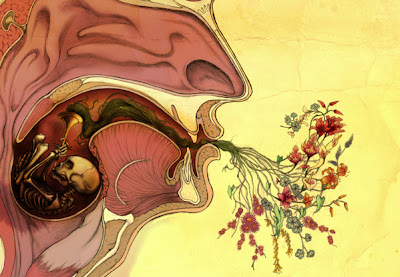

Here are some beautiful anatomical paintings by the artist Jason Mowry.
"My paintings have subject matter that the viewer can feel comfortable exploring. At the very least to give the viewer a glimpse of the ephemeral beauty that is inherent in the natural world and the interior self."
Labels: Anatomical, Anatomy, Behance, Illustration, Jason Mowry, Painting
0 comment Sunday, March 23, 2014 | admin
Under The Microscope is a collection of fascinating microscopic images.
From an artistic perspective, the images have similar qualities to abstract paintings; colour, form, line.
Traditionally, abstract paintings should be independent from the visual references of the world.
As these photographs depict real objects, these pictures are in fact not abstract.
It would be interesting to explore the similarities between real photographs of minute organisms and imagined artworks.
Check out the tumblr page for more great micro-photography.
 Red Pepper
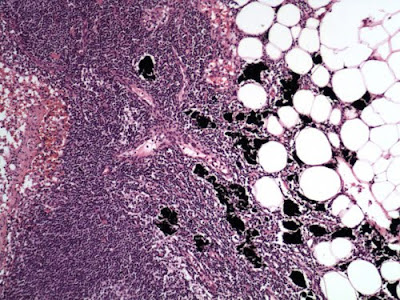 Black Tattoo Pigment
 Peziza
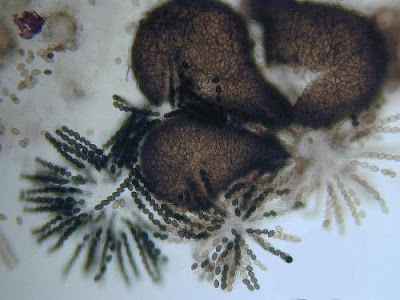 Sordaria
 GMS stain for Pneumocystis carinii
 Compact Bone, Canaliculi, Osteocytes (TPA stain)
 Mycobacterium tuberculosis in lung, Ziehl-Neelsen acid fast stain
From an artistic perspective, the images have similar qualities to abstract paintings; colour, form, line.
Traditionally, abstract paintings should be independent from the visual references of the world.
As these photographs depict real objects, these pictures are in fact not abstract.
It would be interesting to explore the similarities between real photographs of minute organisms and imagined artworks.
Check out the tumblr page for more great micro-photography.
Red PepperBlack Tattoo PigmentPezizaSordariaGMS stain for Pneumocystis cariniiCompact Bone, Canaliculi, Osteocytes (TPA stain)Mycobacterium tuberculosis in lung, Ziehl-Neelsen acid fast stainLabels: Microscope, Microscopic, Painting, Tumblr