


Jamie Mills is a recent first class graduate in Illustration, and has a great portfolio on his website.
From the website, it is evident that Jamie takes a strong interest in nature, structure, pattern and formations.
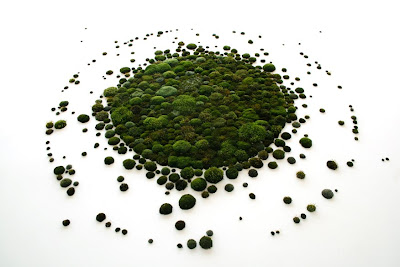
For example, the large circular drawing above was taken from a photograph of dust taken under a microscope.
As an artist myself, I am fascinated by "roundness" so I was drawn to these two illustrations.
I have similar themes within my own artwork, so it is interesting to see these similar thoughts being interpreted in an illustrative way.
Please check out Jamie Mill's website, other than observing patterns in the natural world, he also has a beautiful set of illustrations inspired by endangered animals.
Labels: Art, Artist, Circularity, Endangered Animals, Illustration, Jamie Mills, Universality Of Roundness


What kind of materials do you use and why?
Recently I have been using nature itself in the form of insects and their produce. I feel that I need to witness and observe to gain a greater understanding. You can only read so much from text alone.
Have you always had an interest of nurturing ducks and silk worms? Where did this interest come from?
I suppose my interest in ducks came from buying ducklings at a pet shop whilst buying crickets for an ex partner�s lizards. He was allergic to fur and seemed a good idea at the time even though we both knew nothing about keeping ducks- it is amazing how you are able to buy animals such as these with such little knowledge!
This drove me to research ducks and became quite obsessive with it, I began looking at different breeds.
I then started to hatch my own ducklings from my pets as a second generation. I bought an incubator and all of the hatching equipment I needed.When, inevitably, one of my ducks died naturally, I had to decide whether to intervene or let natural selection take its course.I began using silk worms during my degree, extensively researching their full life cycle and their place in the textile industry.You have been working with insects and creepy crawlies since studying BA
Fine Art, what compelled you to use insects in your art practice?I have always been interested in nature and my family did encourage outdoor activities such as fishing, crab lining and gardening. During my degree, I found insects would take up residence in pre-fabricated constructions.These installations drove my curiosity with our relationship with nature.

In your work, you touch upon human intervention in naural habitats, whydoes this interest you?
How has this been demonstrated in your work?iI am interested in the persistence of nature, natural urges in animals can not be "bred out". We see this when cats bring dead prey in to our homes. I have used nature itself in live installations such as an "Untitled" an installation which I later named "Enclosure". Each individual piece of white tack and thread was placed and hung in a controlled manor to enclose live insects. During the show Giant Silk Moth chrysalises emerged during the show.

For my piece "Global Warming", I used a NASA Ant Farm I bought out of curiosity when looking into human controlled conditions made to contain nature. The ants eventually died, but the enclosed environment inside the ant farm took on a life of its own.

In your work "Contained", you have presented your work in a similar way to
how biologists archive their specimens.
What led you to do this? I wanted to present the household insects in a way as if they were exotic insects encased in a museum.Why have the insects been given human names?
I began to think about how humans naturally co-exist within environments that we fabricate for ourselves. Insects, like us, have a family and are part of a colony. It has been scientifically proven that some insects have differing tolerance levels just as humans do.
 Finally, what do you think about the relationship between art and science?For me I feel both are based on exploration, research, problem solving and obsessions. -
Thanks Joanna! I hope you enjoyed learning about Joanna's work as much as I did!
Labels: Ants, Artist, Butterfly, Candling, Cultivate, Duck, Environment, Farm, Insects, Interview, Joanna Rose Tidey, Moths, Natural Selection, Silk, Unnatural Selection, Vyner Street, Worms

This weekend I went to visit my home city of Manchester, and was intrigued by the title of the exhibition "Dark Matters" at The Whitworth Art Gallery.
I have just finished reading "The 4% Universe" by Richard Panek which explores the idea of dark matter and dark energy within our universe.
The artist Daniel Rozin absolutely steals the show as the first "Dark Matters" exhibit you see on entering, is "Snow Mirror". Silk thread hangs from the ceiling and gives the impression of pretty fairy lights, it is only when you face the installation that you see yourself mirrored in the thread.
I was impressed to say the least, but my mind was blown to pieces when I saw "Peg Mirror" in the next room.


There is a camera placed in the centre of the "mirror", and the pegs oscillate to imitate the surroundings.
I can't begin to understand how Daniel Rozin has created these amazing installations, and for that reason I am absolutely fascinated with them.
If you're in Manchester before the 15th of January 2012, you should definitely check out this exhibition! If not, check out Daniel Rozin's website.
Labels: Artist, Daniel Rozin, Manchester, Mirror, Peg Mirror, Richard Panek, Silk, Snow Mirror, Technology, Thread, Video, Whitworth, Wood, Youtube

Brandon McConnell of Space Paintings . Com uses some unique spray painting techniques to create amazing imaginary visions from outer space.
Labels: Art, Artist, Brandon Mcconnell, Paint, Paintings Universe, Space, Spray, Video
The artists have used a ceramic powder which allows for very fine detail in their work.
Reversing volumes in itself is to be expected when casting an object, however the imprints that are captured using this delicate process really lends itself well to the subject matter.


By copying the surface pattern, and preserving it in ceramic, you are able to view the patterns separated from the original. The formations are caught and held in time.
Labels: Artist, Casting, Ceramic, Formations, Mischer, Traxler, Vegetables
Pery Burge takes macro photographs of ink and produces absolutely stunning results.

"I Looked In To The Time Vortex"

"Cellular Cosmos"

"Apples And Bubbles"

"Solar Echoes"

"Marble Bubbles"
 "Time Portal"
"Yellow Meander"
The colours and abstract flourishes are visually striking and the artist has added names to the pictures to create a whole new dimension of imagination.
For example, the name "Yellow Meander" turns the marbling ink pattern into a strange, beautifully coloured landscape. Different processes create new formations, similar to formations we see in the natural world.
However, the nature of the process adds another layer of interest, at first glance, these images could be finely layered abstract paintings. However, as these are macro photographs of ink in movement, it is unlikely you will ever get the composition exactly the same, ever again.
Each photograph is a moment, never to be captured exactly as before.
The spirit of experimentation in this way, is something that is very much in keeping with this blog. Artists and scientists are both keen experimenters.
Nice work, Pery!
Labels: Artist, Ink, Pery Burge, Photography, Physics
This summer I graduatedfrom my Fine Art degree, and was eager to continue making photograms.I had no access to adarkroom, so I was overjoyed when I came across the fabulousStenoflex pin-hole camera at Fred Aldous, Manchester.
The Stenoflex materialsare packaged compactly inside the little black box that cleverlybecomes the pin-hole camera. When opening the Stenoflex, I was alittle worried that the photo-sensitive paper would be exposed tolight, but the photographic paper comes in its own handy little blackvelcro pouch.
Additional to the paperand box there is:
~ A red gel to coveryour light source, mimicking a traditional dark room light.
~ Developer & Fixer, both of which are labelled in French. Developer is labelled as"Revelateur" and fixer is labelled as "Fixateur".
~ Instructions in bothFrench & English.
To make photograms with the Stenoflex Pinhole Camera Kit you will need:
~ A torch to cover with the redgel to use as your dark room light while you are working. (I used aheadlamp from the pound shop and crudely gaffer-taped the gel on tothe torch making sure the red gel covered all of the light.)
~ 3 trays or bowls foryour developer, fixer and water. I bought a small plastic chest ofdesk drawers from the pound shop (again!) as I didn't want tocontaminate anything I use at home.
~ A light source whichyou can turn on and off again very easily i.e. lamp, torch, mainlight bulb.
~ A space that can bemade pitch black i.e. a cellar, shed, attic, bathroom (with windowscovered). This is very important, you shouldn't be able to seeanything unless you have your red-gel light on.
To Make A Photogram Use These Steps:Find something youwould like to make a photogram of. I used these objects: glassbeaker, dead leaves, soap bubbles, a �10 note, hair, nuts andbolts. The most fun part is experimentation and waiting to see whatit looks like as a photogram!
Assemble yourdeveloper, fixer and rinse trays and put them in to your make-shiftdark room. Switch on your red gel light.
Take your foundobjects in to your darkroom along with your photo-sensitive paperand torch / lamp which should be switched off at this point.
Make sure yourdarkroom is only lit by your red gel lamp, and then remove one pieceof paper from its pouch, making sure to close the pouch afterwardsso that you don't expose the whole pack!
Find a flatsurface and position your found objects on top of thephoto-sensitive paper.
Grab your lightsource (torch, lamp), hold directly over the paper and switch on for1-2 seconds. Your found object is blocking the light from reachingthe paper, and this is how your image is "printed" on to thepaper.
Develop, rinse andfix as normal.This technique willmost likely require a little trial and error, but you can work outhow much light you need to use by looking at your photogram after ithas been fixed.
If your fixed photogramhas gone white it is under-exposed.You have not used enough light oryour found object is blocking too much light from the paper.
If your fixed photogramhas gone black it is over-exposed. Too much light has reached thepaper, or your object isn't blocking enough light.
Here are my results:

Found Object: Soap Bubble blown directly on to photo-sensitive paper.

Found Object: Soap Bubble blown directly on to photo-sensitive paper.

Found Object:Dead Leaves

Found Object: Dead Leaves
 Found Object: Glass Paperweight
See more of my photograms at Melaniek.Co.Uk
Labels: Artist, Britain, Bubbles, Camera, Cameraless Photography, Chemistry, England, Fred Aldous, Home, Leaves, Manchester, Melanie K, Photogram, Pinhole, Science, Soap Bubble, Stenoflex, Uk, United Kingdom
On further research, I found that these photographs are in fact stills from her film Black Moon.


"Black Moon / Hole Punches" (is) derived from the hole punches, or black moons, typically cut by the motion picture laboratory into the first frame of action in film negative. Always left out of the final edited film, these hole punches appear in Siegel�s prints as imperfect black disks or voids cut out of film frames. They are evocative of lunar phases, yet strangely violent in their intercession into the otherwise smooth picture plane." source.
In other words, this "black moon" phenomena is due to a fault in the film. The artist embraces the fault and uses it to her own ends.
The motion-picture film in its entirety explores a post-apocalyptic landscape and the concept of a world with no future. For me, the gaping void in each film still add to the feeling of hopelessness and absence.
Labels: Amie Siegel, Apocalypse, Artist, Black Moon, Circularity, Film, Video

 On the blog, Thinking Through Things I discovered an artist called Shikai Tseng who has just graduated from MA Design Products at The Royal College Of Art.
Tseng says:
"PhotoGraphy" project is the creation of a process in which the environment, time and light react to each other and generate images on three-dimensional objects. The 1st series is about coating objects with a "light-sensitive" layer, put in a black box with strategically placed pinholes, and exposed for 5 to 50 minutes depending on the brightness of the environment. It is a new way to capture a moment in time, no matter whether the image on the object is focused or losing focus � the object will carry the trace of its first moments of experience, its first exposure."
As an artist, I have been experimenting with different photogram techniques and have explored the V & A Shadow Catchers exhibition with great interest. Camera-less photography is something that really captures my imagination, so I am pleased to see natural light-exposure being used in sculpture.
Labels: Artist, Ma Design Products, Photography, Royal College Of Art, Shadowcatchers Exhibition, Shikai Tseng, Victoria And Albert Museum


Anna Garforth has truly mastered the art of "Moss-Graffiti", creating both pieces of art and beautiful letter-work.
The process of moss based art is very exciting.
Crafting In A Green World have a great recipe which is as follows:
Unlike spray paint, moss graffiti is all natural and healthy to work with. You can paint words or images, and the moss fills in like magic! It�s easy as pie to whip up a batch of moss paint. Here�s how, in your blender, combine: One can of cheap beer or 1 1/2 cups buttermilkA few handfuls of mossOne teaspoon of sugarBlend until the mixture is smooth, and you�re ready to get painting! You can use a brush to paint your moss onto concrete walls, rocks, or brick. Mist the moss once a day to help it thrive, and soon your green graffiti will take hold! This method is a great mixture between art, horticulture and science; all of which contain an element of experimentation and surprise.
Labels: Anna Garforth, Artist, Beer, Craft, Garden Art, Garden Craft, Gardening, Horticulture, Moss, Sugar


Dev Harlan - "Parmenides I", 2011 from Dev Harlan on Vimeo.
Harlan experiments with interesting geometric shapes, including the penrose triangle.
The penrose triangle is used in Dev Harlan's work as the artist is inspired by the importance of alignment.
To view the penrose triangle as intended, you must face the sculpture head on.
Facing the sculpture from any other angle, you will not benefit from the illusion. Here is a photograph of a penrose triangle sculpture in East Perth, Australia, viewed from the "wrong" angle.

The artist likens the alignment of the sculpture and viewer, to alignment of planets. To view a full eclipse, we must be in exactly the right orbit for the moon to block light from our sun.
Harlan's multi-disciplinary approach as an artist is also mirrored in his interest in the sciences, exploring ideas of multi-dimensions, optical illusions and the orbits of our solar system.
Labels: Alignment, Animation, Art, Artist, Christopher Henry Gallery, Dev Harlan, Digital, Eclipse, Geometric, O, Penrose Triangle, Planets, Presentation, Projection, Science, Sculpture, Viewer, Vimeo


To create, an artist must mix substances. Traditionally, pencil meets paper, paint meets canvas, plaster meets water. However, as art progresses, artists become more experimental with materials.
In the case of Roger Hiorns, copper sulphate has been applied to a disused council flat to create this crystallized set of rooms. The artist has pumped the copper sulphate in to the flat, left the solution to crystallize at a cool temperature and then drained the solution back out again.
"I'm not a scientist. I'm more concerned with starting a natural process which will go on happening by itself. It's never ending. It won't stop, whatever you do."
source
It is interesting that Hiorns does not identify as a scientist, but as an artist instead. This work displays a defined balance between order and chaos. The scientific process in which the crystals have been created would need to have been very precise, however chaos dictates when and where the crystals will grow.
Additionally, as visitors to "Seizure" crush the crystals on the floor and brush against the walls, the work evolves as people pass through.
Labels: 2009, Artist, Chemistry, Crystal, Crystallised, Crystallization, Roger Hiorns, Seizure, Tate, The Turner Prize